
When most people hear “ethical hacker,” they picture someone in a dark room surrounded by monitors, typing furiously while green code scrolls down the screen. Hollywood really ran with that one.
Real life is way less dramatic. And way more useful, honestly.
I’ve watched something change over the last few years. Business owners, startup founders, creators, people running small online shops — more of them are paying attention to cybersecurity now. Someone reads about a data breach, or a friend loses access to their business Instagram overnight, and suddenly they’re wondering if they should be doing something. If they’re already too exposed.
Usually the answer is yes. Particularly if you’d rather deal with a problem before it actually becomes one.
Before you go hiring someone though, there’s a few things worth getting straight.
The Mistake That Keeps Biting People
The assumption I keep running into: people think you bring in an ethical hacker after something goes wrong. Damage control. Incident response.
It’s completely backwards.
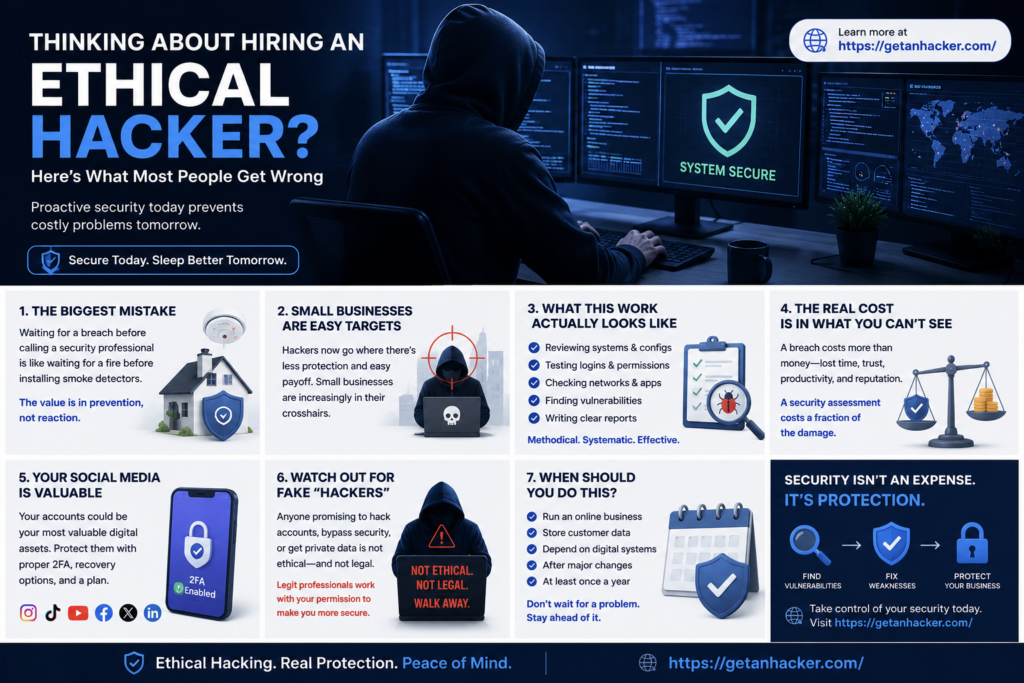
Waiting for a breach before calling a security professional is like deciding you don’t need smoke detectors because your house hasn’t burned down yet. The value is almost entirely upfront. Every website, employee login, cloud account, business email — each one is a door. Most organizations have no idea how many unlocked doors they have until someone actually walks through checking.
That’s what these professionals do. They check your doors before someone with worse intentions does.
Because those people are already checking. Constantly.
Small Businesses Are Now the Easier Target
For a long time hackers went after large corporations. Made sense — that’s where the money was.
That calculation has shifted.
Small businesses tend to run lean. Less dedicated IT support, older software, nobody whose actual job is watching for threats. From an attacker’s perspective that’s a good combination — lower resistance, still a decent payoff.
I’ve seen local businesses locked out of their own websites for days over something patchable in an afternoon. Seen online stores unknowingly expose customer data because a plugin hadn’t been touched since 2019. In several cases the owner only found out when customers started calling with complaints.
What’s frustrating is almost all of it was preventable. A basic security assessment would have caught it early.
What This Work Actually Looks Like Day to Day
Ignore the movie version. Most of the job is reading documentation, poking at configurations, testing login flows, reviewing who has access to what, and writing up what gets found. It’s methodical work. Nobody’s dramatically smashing through firewalls — they’re carefully and systematically looking for cracks.
What typically gets examined: website security, cloud environments, employee permissions, business applications, email systems, network infrastructure. And what turns up usually surprises the client.
Sometimes it’s an admin account with a password like “company2021.” Sometimes it’s software with publicly known vulnerabilities sitting unpatched for years. Sometimes it’s a misconfiguration that’s been quietly exposing internal data to the open internet, and nobody noticed.
Catching that stuff early means fixing it calmly, on your own timeline. Not in a full panic at 2am.
Why People Keep Putting This Off
Security spending is hard to justify because it doesn’t generate revenue. I genuinely understand the hesitation — you’re paying for something you hope you never need.
But the math shifts pretty fast the moment something actually goes wrong.
Recovering from a cyber incident isn’t just a technical fix. It’s lost time, lost productivity, customer notifications, potential legal exposure, and then the slower, harder to quantify damage of people simply trusting your business less. That reputation hit tends to linger a lot longer than the technical problem itself.
A security assessment costs a fraction of any of that. Usually a small fraction.
Your Social Media Is Probably Worth More Than You’re Treating It
This is the one people tend to dismiss until it’s too late.
For creators, agencies, or any business that’s built an audience online — those accounts might genuinely be among your most valuable digital assets. Lose access to an account you’ve spent years building and the damage lands immediately.
I’ve talked to business owners who’ve been through it. Some recovered. Others lost something they couldn’t fully get back.
Ethical hackers help with this more and more — reviewing two-factor setup, checking recovery options, making sure there’s actually a plan if access gets lost. None of it is complicated. But it’s almost always deprioritized until someone’s already locked out.
There Are A Lot of Fake “Hackers for Hire” Out There
This part matters, so don’t skim it.
Search online and you’ll find plenty of people selling services that aren’t legitimate — accessing accounts without permission, bypassing security on someone else’s behalf, pulling private information the client has no right to see.
That’s not ethical hacking. That’s just regular hacking, and it doesn’t become legal because you paid for it.
A legitimate security professional operates with your explicit authorization, stays within legal limits, and the entire point of their work is making your systems harder to compromise. Anyone promising to access accounts without consent or retrieve private data for you is not operating ethically — or legally. That’s a clear signal to walk away, regardless of how the service is packaged.
When Should You Actually Do This?
You don’t have to wait for an incident. Waiting is genuinely the worst strategy here.
If you run an online business, store customer data, depend on social media, recently launched a new site or app, or simply haven’t looked at your security setup in a few years — an assessment is probably overdue.
The bigger your digital footprint gets, the more it matters to actually know where the weak points are.
Last Thought
The threat environment keeps getting more complicated. Tools that used to require serious technical skill are now widely accessible, which means the pool of people capable of causing damage keeps growing. Security isn’t a one-time project anymore.
None of this is about fear. You lock your office. You insure your equipment. You protect your finances. Your digital assets deserve the same basic level of care — and most of the problems that end up becoming headlines could have been caught and fixed long before they got there.
That’s what this work is really about. Finding problems while they’re still quiet.