
For a surprising number of business owners, cybersecurity sits in the same mental category as insurance paperwork. You know it’s probably important. You know you should pay attention to it. But unless something forces the issue, it tends to stay at the bottom of the list. That’s understandable.
Most people start businesses to sell products, provide services, build something useful, or solve a problem. Very few wake up excited to think about password policies, cloud configurations, or whether an old employee account still has access to company systems. The problem is that cybercriminals know this. And increasingly, they’re counting on it.
The Myth That Hackers Only Target Big Companies
For years, there was a common belief that hackers only cared about large organizations. If you weren’t a bank, a multinational retailer, or a government agency, you probably assumed nobody would waste time targeting your business.
That may have been somewhat true years ago. Today, it isn’t. Most cyberattacks aren’t personal. Nobody is sitting in a dark room specifically targeting your local accounting firm or family-run eCommerce store.
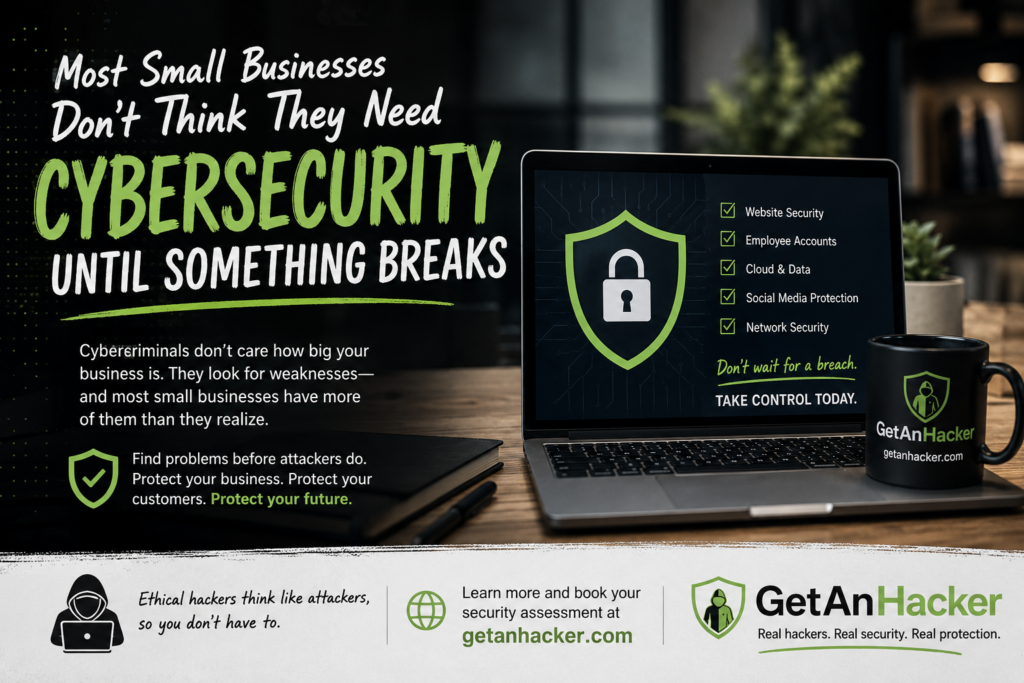
Modern attacks are often automated. Software continuously scans the internet looking for websites running outdated software, exposed databases, weak passwords, and unsecured cloud storage. Attackers don’t necessarily care who you are. They care whether you have a weakness they can exploit.
Why Your Business Is More Exposed Than You Think
Ask most business owners what technology they use, and they’ll usually mention their website and email.
But the reality is much bigger. A typical business may also rely on:
- Customer databases
- Cloud storage platforms
- Social media accounts
- CRM systems
- Payment gateways
- Employee laptops
- Remote work tools
- Marketing software
- Third-party integrations
Every one of these systems contains valuable information. And every one of them represents a potential entry point for attackers.
The question isn’t:
“Why would someone target us?”
The question is:
“What would they find if they did?”
For many businesses, the answer is probably more than they realize.
The Security Issues Nobody Notices
One of the biggest misconceptions about cybersecurity is that attackers only exploit highly technical vulnerabilities. In reality, many successful attacks begin with surprisingly simple mistakes. During security assessments, professionals regularly discover issues such as:
Former Employee Accounts Still Active
Staff members leave, but their accounts remain accessible months or even years later.
Weak or Reused Passwords
Employees often use the same password across multiple platforms, creating a chain reaction if one account is compromised.
Missing Multi-Factor Authentication
Many critical accounts still rely solely on passwords for protection.
Outdated Software
Old plugins, applications, and operating systems often contain known vulnerabilities that attackers actively search for.
Excessive User Permissions
Employees sometimes retain access to systems and information they no longer need. None of these problems sound dramatic. But together, they’re responsible for a significant number of successful cyberattacks every year.
What Ethical Hacking Actually Means
The term “ethical hacking” sounds mysterious to many business owners.
In reality, it’s much simpler than it sounds. An ethical hacker is someone you authorize to look for vulnerabilities before cybercriminals find them. Instead of attacking your systems for personal gain, they’re helping you identify and fix weaknesses.
Think of it this way:
If you owned a building, you’d probably want a security expert to check every door, lock, and window before a burglar did. Ethical hacking works the same way. You’re not paying someone to create problems. You’re paying someone to uncover problems that already exist.
The Real Cost of a Security Breach
When businesses think about cybersecurity investments, they often focus on immediate costs.
But they rarely consider the cost of doing nothing. A security breach can lead to:
- Revenue loss from downtime
- Recovery and remediation expenses
- Legal complications
- Regulatory penalties
- Customer notification requirements
- Reputation damage
- Loss of customer trust
- Operational disruption
The financial impact is often only part of the story. Trust can take years to build and only moments to lose. For smaller businesses, the damage can be especially difficult to recover from because resources are already limited.
Why IT Support Isn’t the Same as Cybersecurity
Many companies assume their IT provider is already handling cybersecurity. While IT support is important, the two roles are not identical. IT professionals typically focus on:
- Keeping systems running
- Installing updates
- Supporting users
- Maintaining infrastructure
- Resolving technical issues
Cybersecurity professionals approach things differently. Their job is to think like attackers.
Instead of asking:
“Is everything working?”
They ask:
“How could someone exploit this?”
A system can function perfectly while still containing serious vulnerabilities.
That’s why dedicated security assessments provide value beyond routine IT maintenance.
The Overlooked Risk of Social Media Accounts
Many businesses spend years building audiences on platforms like LinkedIn, Facebook, Instagram, and X. Yet these accounts are often protected by surprisingly weak security practices.
Common problems include:
- Shared passwords
- No multi-factor authentication
- Too many administrators
- Former employees retaining access
If a business loses control of its social media accounts, the consequences can include customer scams, fraudulent posts, reputation damage, and lost advertising assets. For many companies, social media has become a core business asset.
It deserves the same protection as any other critical system.
Cybersecurity Is Not a One-Time Project
One of the biggest mistakes businesses make is viewing cybersecurity as a task that can be completed once and forgotten.
- Technology changes constantly.
- New software gets installed.
- Employees join and leave.
- Systems are upgraded.
- Integrations are added.
Every change creates new opportunities for vulnerabilities to appear. A security assessment completed two years ago may no longer reflect your current environment. That’s why cybersecurity works best as an ongoing process rather than a one-time exercise.
Final Thoughts
The reality is simple. Every business operating online has something worth protecting.
- Customer information.
- Financial records.
- Business communications.
- Brand reputation.
- Operational continuity.
Cybercriminals are no longer focused exclusively on large enterprises. They’re looking for opportunities. The businesses that stay safest aren’t always the ones spending the most money. They’re the ones that understand their risks, regularly assess their exposure, and address vulnerabilities before attackers find them.
Cybersecurity isn’t just an IT concern anymore. It’s a business responsibility.
And when a vulnerability exists, it doesn’t matter whether your company has ten employees or ten thousand. The only thing that matters is who finds it first.