
If you’ve been researching cybersecurity services, you’ve probably come across terms like ethical hacking, penetration testing, vulnerability assessment, and security audit.
Many people assume they’re all the same thing. They’re related—but they’re not identical. Understanding the difference can help you choose the right security service for your business and avoid paying for something that doesn’t solve your actual problem.
Let’s break it down.
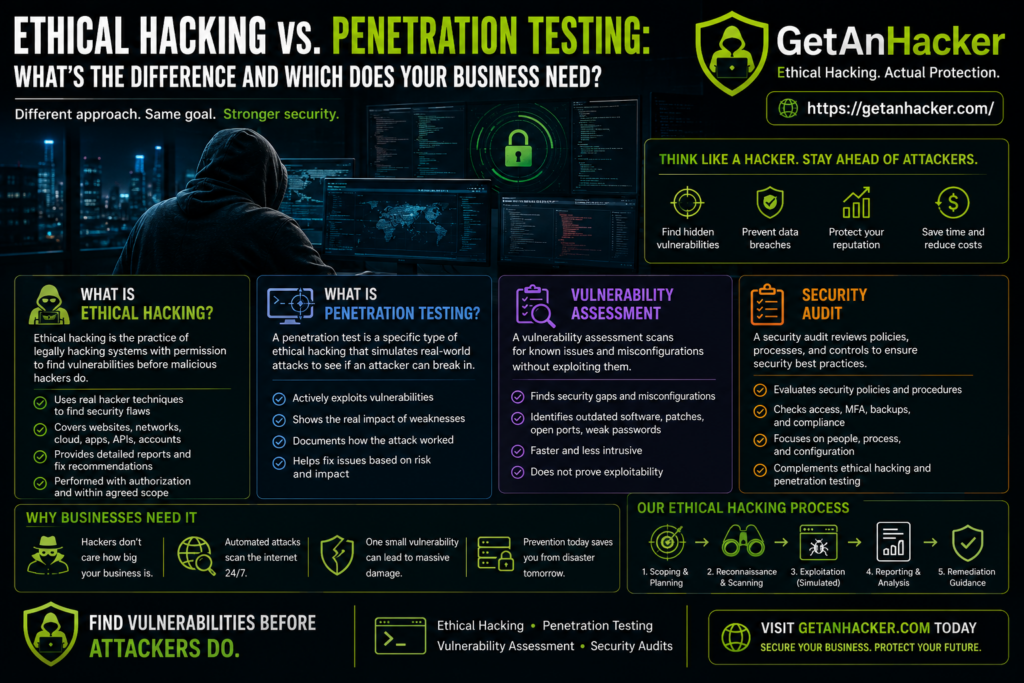
What Is Ethical Hacking?
Ethical hacking is the practice of legally attempting to compromise computer systems with the owner’s permission. The objective isn’t to cause damage. It’s to think and act like a real cybercriminal so security weaknesses can be identified before malicious hackers discover them.
Ethical hackers simulate real-world attacks against:
- Business websites
- Web applications
- Company networks
- Cloud infrastructure
- Employee accounts
- APIs
- Mobile applications
- Social media accounts
Every test is performed under strict authorization and within an agreed scope.
Professional ethical hackers document every vulnerability they discover and provide recommendations for fixing each issue.
At GetAnHacker (https://getanhacker.com/), ethical hacking is designed to uncover hidden weaknesses before attackers can exploit them.
What Is Penetration Testing?
Penetration testing—often called a pen test—is a specific type of ethical hacking. Think of ethical hacking as the overall profession. Penetration testing is one of the services ethical hackers perform. A penetration test focuses on one goal:
Can an attacker successfully break into your systems?
During a penetration test, security professionals actively attempt to exploit vulnerabilities using controlled attack techniques.
If they gain access, they carefully document:
- How the attack worked
- What data could have been accessed
- How serious the vulnerability is
- How it should be fixed
Rather than simply identifying weaknesses, penetration testing demonstrates the real-world impact of those weaknesses.
What Is a Vulnerability Assessment?
A vulnerability assessment is different. Instead of actively exploiting systems, security professionals scan for known vulnerabilities.
Typical findings include:
- Outdated software
- Missing security patches
- Weak passwords
- Exposed services
- Configuration errors
- Unsupported software
Think of it as creating a comprehensive checklist of security issues.
It’s generally faster and less expensive than penetration testing, but it doesn’t prove whether vulnerabilities can actually be exploited.
Security Audit vs. Ethical Hacking
Security audits focus on compliance and best practices.
Auditors review policies, procedures, access controls, documentation, and system configurations.
Questions they ask include:
- Is MFA enabled?
- Are backups performed regularly?
- Who has administrator access?
- Are employees following password policies?
- Are systems updated?
An audit evaluates whether security controls exist. Ethical hacking evaluates whether those controls actually work against an attacker. Most mature organizations perform both.
Why Businesses Need Penetration Testing
Many cyberattacks don’t involve sophisticated hacking techniques.
Instead, attackers exploit simple mistakes such as:
- Weak administrator passwords
- Forgotten employee accounts
- Public cloud storage
- Outdated plugins
- Misconfigured firewalls
- Poor access permissions
Penetration testing identifies these weaknesses before criminals do.
The results often surprise business owners because vulnerabilities are frequently hidden beneath systems that appear to function perfectly.
Who Should Consider Ethical Hacking?
Ethical hacking isn’t just for enterprise companies.
Businesses that should consider regular testing include:
- Ecommerce stores
- Healthcare providers
- Financial businesses
- Marketing agencies
- SaaS companies
- Law firms
- Educational institutions
- Manufacturers
- Any organization storing customer information
If your business depends on technology, cybersecurity should be treated as an ongoing investment rather than a one-time project.
How Often Should Penetration Testing Be Performed?
Cybersecurity isn’t static. Your business changes constantly. New employees join. Software gets updated. Websites are redesigned. Third-party integrations are installed. Cloud environments expand. Each change can introduce new vulnerabilities.
Most cybersecurity professionals recommend penetration testing:
- Once every year
- After launching a new website
- After major software upgrades
- Before handling sensitive customer data
- After significant infrastructure changes
Regular testing helps ensure your security evolves alongside your business.
What Happens After the Test?
A professional ethical hacking engagement doesn’t end when vulnerabilities are found.
Instead, you’ll receive a detailed report explaining:
- Every identified vulnerability
- Risk severity
- Evidence of exploitation
- Screenshots where applicable
- Business impact
- Recommended remediation steps
This allows your development or IT team to fix issues in order of priority.
Many organizations schedule follow-up testing after remediation to verify that vulnerabilities have been properly resolved.
Final Thoughts
Cybersecurity isn’t about hoping attackers ignore your business. It’s about making your business a difficult target. Ethical hacking helps you understand how an attacker thinks. Penetration testing proves whether your defenses actually work. Vulnerability assessments identify weaknesses before they’re exploited. Together, these services provide a realistic picture of your organization’s security posture. If you’ve never had your systems professionally tested, now is the time.
The experts at GetAnHacker help businesses identify vulnerabilities through ethical hacking, penetration testing, and comprehensive security assessments—allowing you to fix problems before they become expensive cyber incidents. Because it’s always better to discover a vulnerability during a controlled test than during a real attack.