
For most small business owners, cybersecurity has never really felt like their problem.
And honestly, up until pretty recently, that wasn’t entirely unreasonable. The businesses making headlines after breaches were banks, hospital networks, retailers with millions of customers. Not the 15-person marketing agency or the family-run e-commerce store. So it got filed away under “things larger companies deal with” and left there.
The problem is that’s not really how it works anymore — and for a lot of businesses, that gap between perception and reality is becoming genuinely costly.
Nearly every business today has more digital exposure than it realizes. There’s the website, obviously. But also the cloud storage your team uses, the payment processor, the email platform, the social media accounts you’ve spent years building, the customer database sitting somewhere in the background. Most business owners, if you asked them to list everything, would miss half of it.
All of that is a potential entry point for someone looking for one.
And the frustrating thing is that most attacks aren’t targeted in the way people imagine. It’s not some guy in a basement who’s decided your specific business is worth going after. It’s mostly automated — bots crawling the internet looking for anything with a known weakness, logging what they find, and flagging it for exploitation. Your company’s size doesn’t factor into it. Your revenue doesn’t factor into it. If there’s a detectable gap, it gets found.
Small businesses actually tend to have more of those gaps, not fewer. Not because the owners are negligent — just because nobody’s specific job is closing them. The IT provider is keeping things running. The marketing person is managing the accounts. The owner is doing everything else. Security just falls in between, quietly accumulating problems nobody’s looking for.
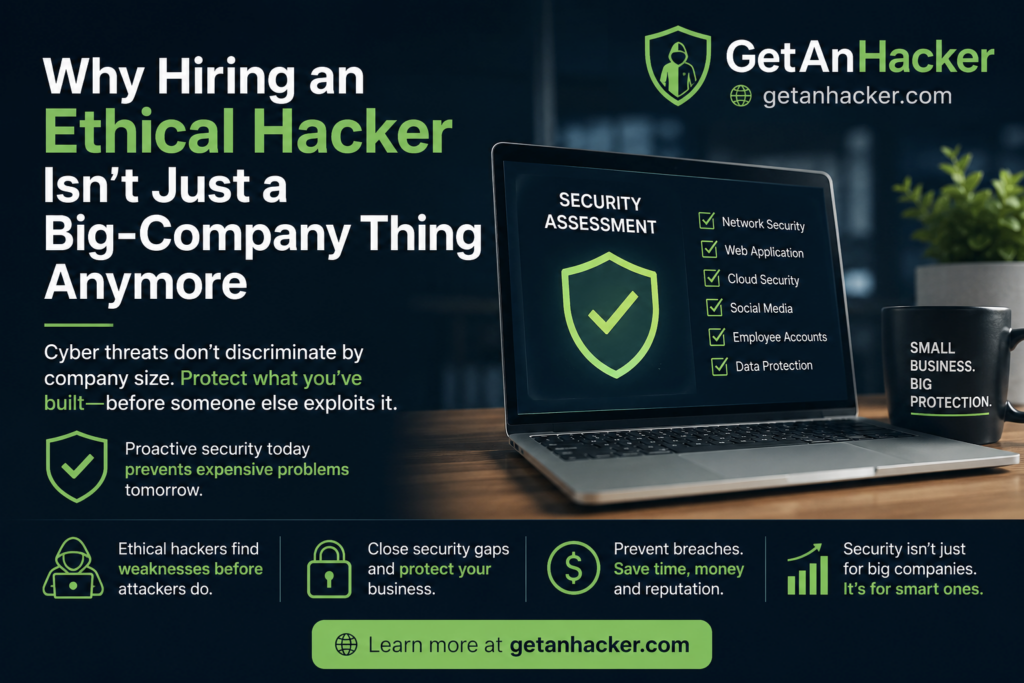
So what is an ethical hacker, actually
The name is confusing and I think it puts people off more than it should.
Strip it back and it’s pretty simple: you’re hiring someone to try to get into your own systems before someone else does. They look at your website, your network, your employee accounts, your cloud setup — with your permission, legally — and they tell you what they found and how they got there.
The locksmith analogy gets used a lot but it holds up. You want someone testing whether the locks actually work before you need to find out the hard way. Same idea here, just applied to logins and software configurations instead of deadbolts.
What they find is usually less dramatic than people expect. It’s rarely some sophisticated never-before-seen vulnerability. More often it’s an old employee account nobody deactivated. Passwords that haven’t changed since the business launched. A cloud folder accidentally set to public. Software running months behind on patches. An important account with no two-factor authentication because nobody got around to setting it up.
None of that requires a skilled attacker to exploit. It just requires someone paying attention — and there’s a lot of automated attention being paid, constantly.
The cost calculation people get wrong
When most business owners think about getting a security assessment, they’re comparing the cost against nothing happening. Against the status quo continuing indefinitely.
That’s the wrong comparison, and it makes security spending look harder to justify than it actually is.
The real comparison is: what does this cost versus what does a breach cost?
Because when something goes wrong it usually goes wrong in several directions at once. The website’s down, so revenue stops. Customer data may have been accessed, which opens up a whole separate set of problems — legal exposure, regulatory notifications, the conversation with your customers about what happened to their information. Your team loses access to tools they need. Work stops while everyone figures out what’s going on. Then come the outside consultants, the forensics, sometimes rebuilding infrastructure from the ground up.
Businesses routinely spend several times more cleaning up after an incident than any security assessment would have run them. But that calculation doesn’t happen in advance. In advance, people are comparing a real number against a theoretical risk that hasn’t materialized yet. It’s only afterward that the math becomes obvious.
What about the IT provider?
This comes up constantly and it’s worth being straightforward about, because a lot of businesses genuinely believe this is already covered.
IT support and security testing are different disciplines with different goals. Your IT provider’s job is keeping your systems functional — making sure things work, handling updates, resolving issues when they come up. They’re asking whether everything is operating the way it’s supposed to.
A security professional is asking something else: how would someone break this?
Those questions lead to completely different places. A system can be running perfectly and still have a vulnerability that lets an attacker in through a side door. The IT provider wasn’t looking for that. They weren’t supposed to be. Security testing approaches your setup the way an attacker would — from the outside, looking for anything that can be pushed on.
Both things matter. They’re just not the same thing, and assuming one covers the other is where businesses tend to get into trouble.
Social media specifically
This one tends to get dismissed until someone in your industry gets hit and suddenly everyone’s paying attention.
Business social accounts aren’t just content channels. They represent real accumulated value — a built audience, advertising history, customer relationships, years of credibility. Losing control of them is genuinely damaging. Fake posts going out under your brand. Followers getting scammed. The account flagged and suspended for activity you didn’t do. Ad accounts wiped.
And it usually happens through basic stuff. A shared password. Too many people with admin access, including some who left the company two years ago. No two-factor authentication on the main account. Things that take maybe an afternoon to properly sort out, but never get prioritized until something goes wrong.
This doesn’t stay fixed on its own
Getting a security review done and considering it handled is a pretty common mistake.
Your environment changes constantly whether you’re paying attention to it or not. New tools get added. Staff turns over. The website gets updated. A routine software patch introduces a new gap. Something that was fine eighteen months ago might not be fine today, and you’d have no way of knowing unless someone goes looking again.
The businesses that handle this well tend to treat security as something ongoing rather than a project with an end date. Doesn’t have to be constant — an annual review, or a review any time something significant changes — but it has to be a recurring thing rather than a one-time box tick.
A quick note worth including: not everyone advertising these services is legitimate. There are people in this space operating well outside legal and ethical limits, and the consequences of hiring the wrong one are obvious. Legitimate security professionals work with written authorization, stay within agreed scope, and document everything clearly. Anyone offering to access accounts you don’t own or work on systems without permission isn’t offering security services. It’s worth being careful about who you hire and asking the right questions before you do.
There’s no perfect moment to get a security assessment done. But if your business runs online in any meaningful way, if you hold customer data, if you’ve never had one done — it’s probably overdue.
Most incidents don’t begin with a sophisticated targeted attack. They begin with a gap that was sitting there quietly, unnoticed, until someone stumbled through it. An account that should have been closed. A setting nobody looked at twice. A password that was fine when it was set three years ago.
That’s the stuff these assessments are built to find. Not to create urgency where there isn’t any — just to give you an accurate picture of what’s actually there. Because the alternative is finding out some other way, and that tends to be a much more expensive education.